Decks
Composite decking vs wood decking: boards, frame and upkeep
Composite costs more to buy and less to keep, while wood takes a fresh coat every few seasons. The frame under either is almost always treated lumber, and Trex wants composite joists no more than 16 in. on centre.
- Published
- Reading time
- 5 min read
- Written by
- Sonce Homes
Composite or wood decking: the short answer
Composite decking vs wood decking trades money now against work later. Composite costs more to buy and less to keep: it is cleaned with soap and water, where wood needs a fresh coat every few seasons. The frame under either is almost always treated lumber, and Trex wants joists under composite no more than 16 in. on centre [Trex].
Every composite number on this page is Trex's, one manufacturer's rules for its own boards. Ask the maker of whatever you buy for theirs.
What counts as a wood deck: cedar or treated lumber
On this page a wood deck means cedar or pressure-treated lumber, the two woods Sonce builds with. Cedar is lighter, stays flatter and takes stain well. Pressure-treated lumber costs less and is the usual choice for the frame under either kind of board.
Treated lumber is not all one product. Lumber treated for ground contact has a higher preservative retention level than lumber treated for above-ground use [Wood Preservation Canada], so a piece that will touch the soil is a different purchase from a deck board.
This page does not assess tropical hardwood.
What a composite board is made of
Trex says its composite decking is made from 95% recycled and reclaimed materials [Trex]. Its Transcend and Transcend Lineage boards add a proprietary shell that, Trex says, protects against fading, staining, scratching, mould and mildew [Trex].
That is one maker's recipe. This page has no split between wood fibre and plastic to give you, and it does not compare capped, uncapped or PVC boards. For any board you price, ask the maker what it is made of and what its shell, if it has one, covers.
Look and feel: grain you stain or colour that holds
Wood can be stained in the tone you choose or left to weather. Composite keeps its colour and is cleaned with soap and water.
That colour comes with fine print. Trex puts an asterisk on the fading and staining protection on its product page [Trex], so read the footnote for the exact line you are buying before you count on the colour holding.
What makes one deck cost more than the other
This page gives no dollar figures, because the gap in material and installation depends on the deck. Four things move it:
- The boards, the part everyone compares.
- The frame. Composite's closer joist spacing, and on an old frame the extra joists, add lumber and labour that a board price does not show [Trex].
- The railing. Cedar spindles, aluminium balusters between wood posts and glass panels differ in upkeep and in what they cost.
- The upkeep. Wood takes a fresh coat every few seasons; composite takes a wash.
Set the last item against the first before you decide.
How much upkeep does each deck need?
Wood needs a fresh coat every few seasons, whether you stain or seal it. Cleaning composite takes soap and water. "Every few seasons" is Sonce's rule of thumb rather than a fixed staining or sealing schedule, so check what the maker of your product says.
Winter is where composite comes with written rules. Trex's 2018 winter-care guide for its Transcend, Enhance and Select lines says calcium chloride or rock salt can be used to melt snow and ice from the deck surface [Trex]. What it warns about is the shovel.
Which lasts longer, and what does a warranty promise?
No lifespan in years is sourced here for either material. The closest thing to a number is the composite warranty term below.
For wood, the case rests on the species. The Western Red Cedar Lumber Association says western red cedar is naturally resistant to rot, decay and insect attacks [Western Red Cedar Lumber Association], which is the cedar industry describing its own product. For composite, the case is the shell described above, and its fading and staining claims carry that asterisk.
A warranty term is not a forecast of how long boards last, and Trex's changes with the line, so compare the terms for the board you are buying.
What changes under the boards
Trex's installation guides set joist spacing for composite, and an old frame at 24 in. does not meet it. These are Trex's rules for its own boards [Trex]:
| Situation | Trex's rule |
|---|---|
| Standard composite installation | Joists generally no more than 16 in. on centre |
| Boards laid diagonally to the joists | Joists at 12 in. |
| Composite going onto an old frame at 24 in. on centre | Add one joist between each existing pair |
| Gap between the long edges of two boards | 3/16 in. in all weather |
The gap is there because boards move. Trex says most deck boards expand when outside temperatures heat up and contract when they cool down [Trex], and it sets one gap for its composite in every season.
The frame stays treated wood whichever boards go on top. Wood Preservation Canada advises quality, exterior, corrosion-resistant fasteners approved under the building code for pressure-treated wood [Wood Preservation Canada].
How to choose, and whether swapping boards needs a permit
Choose on upkeep, winter use and the frame you already have.
- If you will not re-coat a wood deck every few seasons, that settles it: composite.
- If you want to pick the stain tone and do not mind the coat, wood is the cheaper deck to buy.
- If you shovel all winter and choose composite, use a plastic shovel.
- If you want composite on an old wood frame with joists at 24 in., plan on new joists first.
Swapping boards is a lighter question than building. The Town of East Gwillimbury lists repairs or replacement of deck boards among projects exempt from a building permit [Town of East Gwillimbury]. A whole new deck is a different matter: Margot Bai, whose old deck was replaced with a new one, wrote that her builder "passed all the inspections required by the Town of East Gwillimbury." Our guide to deck permits in York Region covers when each town asks for one.
Cedar, treated or composite: how Sonce builds each
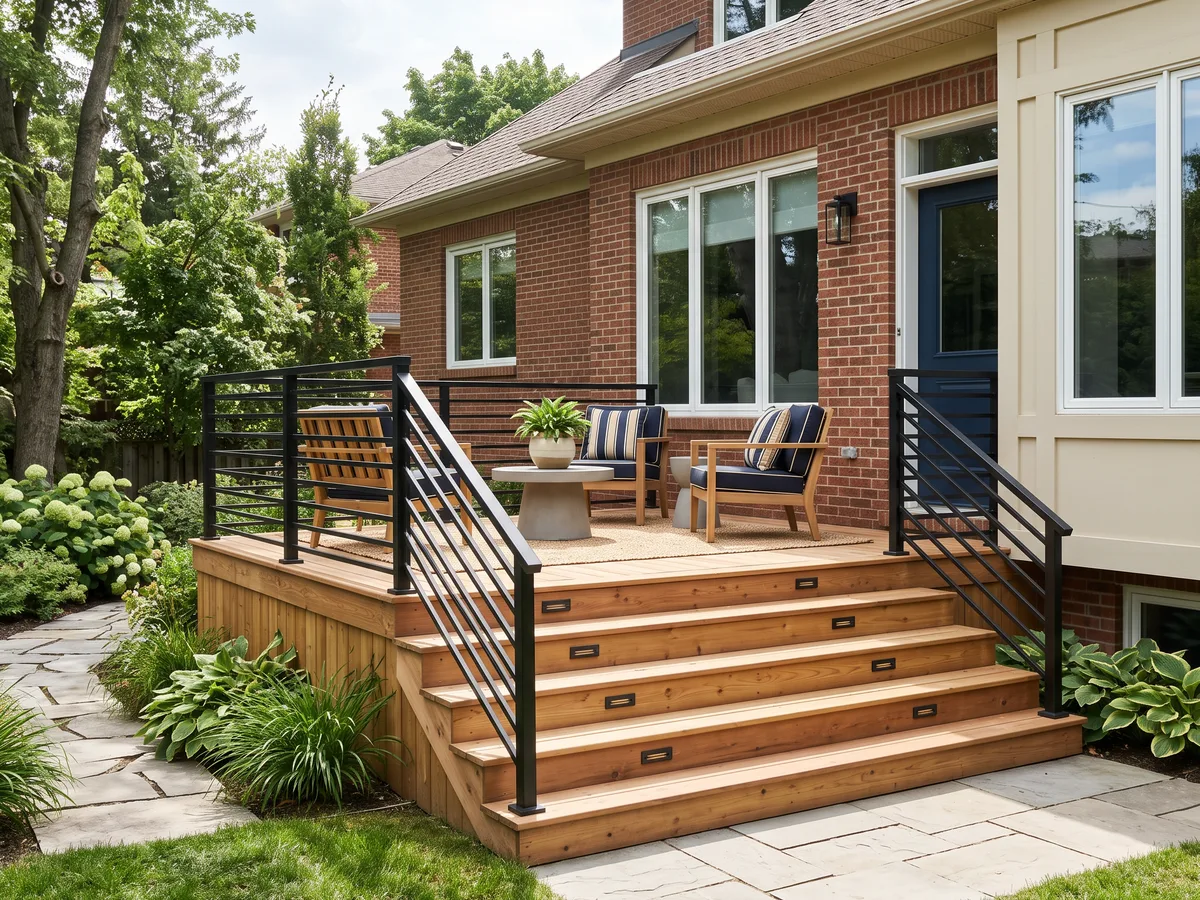
Sonce builds decks in all three: cedar, pressure-treated lumber and composite boards. A composite deck goes on a wood frame, with cedar posts and rail caps and aluminium balusters. Either way, you see a measured layout and a rendering of the deck before any lumber is ordered.
On an existing deck the frame is checked first. If the posts, beams and joists are sound, new boards can go onto the existing structure. If the frame has rotted or shifted, new boards only hide the problem.
Vladimir Markhevka, who moved to composite, wrote: "We just upgraded our deck to a beautiful composite platform." When you ask about yours, bring two answers: how you will use the deck, and how much upkeep you are willing to give it.